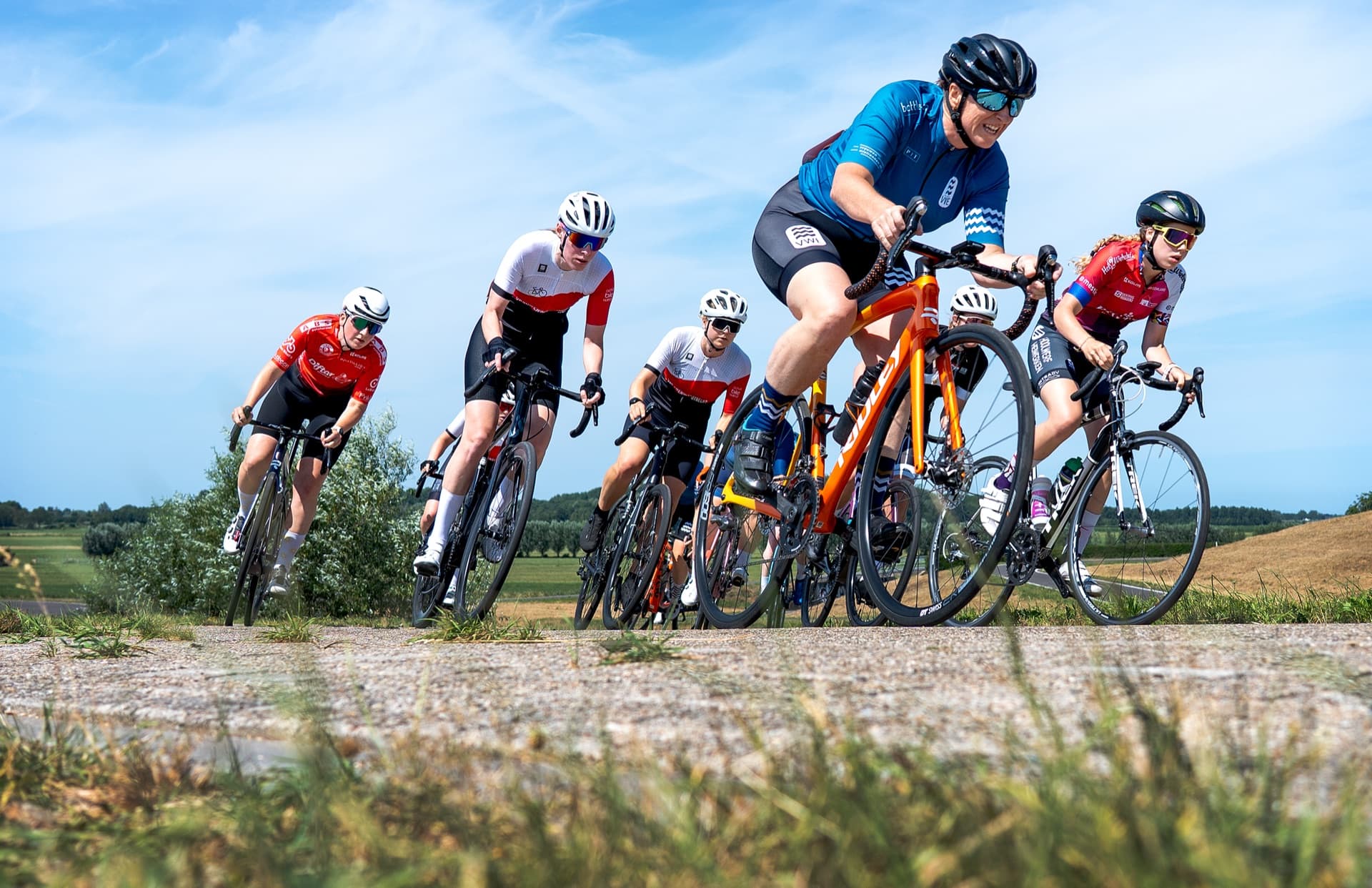
Photo: Tamar Huijbregts.
The power of a fitting offer
Last week we spoke with Nelly Voogt, independent process facilitator and active in women's cycling for over thirty years. We talked about her work and her commitment to equality in cycling. In this interview, Nelly explains why a fitting offer, cultural change and board-level responsibility are essential to create more balance and equality.
Who I am & my road into cycling
"I am Nelly Voogt, an independent process facilitator, and I have been involved in women's cycling for almost thirty years. I support clubs on themes such as member engagement and culture. I have also founded my own training group, and we organise accessible races.
My own cycling journey started when I was fourteen, in 1980. Because there was only one competition level at the time, many women dropped out, even though they enjoyed cycling. I noticed a need for training sessions with a lower entry level and without the pressure of having to ride at a level that didn't suit them. From that conviction I set up a training group, which has since grown into six groups across the Netherlands."
Why equality matters so much to me
"For me it is almost self-evident: that there are training and competition opportunities for riders of different levels.
Balance in equality means that a club's offer fits the group practising the sport. More and more women are active in cycling. That makes a fitting offer from the club essential. If you only offer training races for experienced men averaging forty kilometres per hour, you miss a large group of riders — women and men."
The role of clubs and board members
"Boards have the responsibility to create a diverse offer now that the population of cyclists has changed. It helps when people from the target group take a seat on the board, so their perspective is taken into account. Representation creates insight into what different groups need.
If you want to be a good reflection of the athletes in your area, that means something for your offer and the culture of your club."
Working with Stichting SAM & concrete steps
"Through Henk van Beusekom (KNWU) I became involved with Stichting SAM, because I had given the workshop "Women and girls to the club!" for a number of KNWU clubs.
Together with SAM we are now setting out. This autumn, three meetings will be organised and SAM will be present at events to gather input using the ECHO method. In addition, a study is being conducted through the Mulier Institute. Together, those results will form the basis for an intervention that can help clubs take the next step."
An inspiring example from practice
"Cycling club Eemland in Amersfoort is a wonderful example. A trainer there has set up a separate training evening for women. By organising and facilitating that, an enormous pull effect emerges.
More and more women are joining, and some progress to mixed training sessions. It shows that when you organise something that meets the need, something really happens."
Impact for athletes & my view of the future
"Cyclists notice that they can train at their own level. They feel seen and dare to take part. That makes the sport more accessible and more fun.
In five years, I hope more clubs will follow an approach like Eemland's. That there will be an offer for both men and women, beginners and advanced riders. Not just focused on elite sport, but fitting the broad group of cyclists we have today."
My personal ambition & message to the world of sport
"I hope that my training groups will eventually become superfluous because clubs offer diverse and accessible programmes.
My message to clubs is simple: "Does your offer still fit the current group of cyclists? If not, involve them and organise activities that meet their needs.""
This article was automatically translated from Dutch. Read the original Dutch version.
Photo: Tamar Huijbregts.